How to Read a Flooring Quote: Square Metres, Packs, Waste and Prep Explained
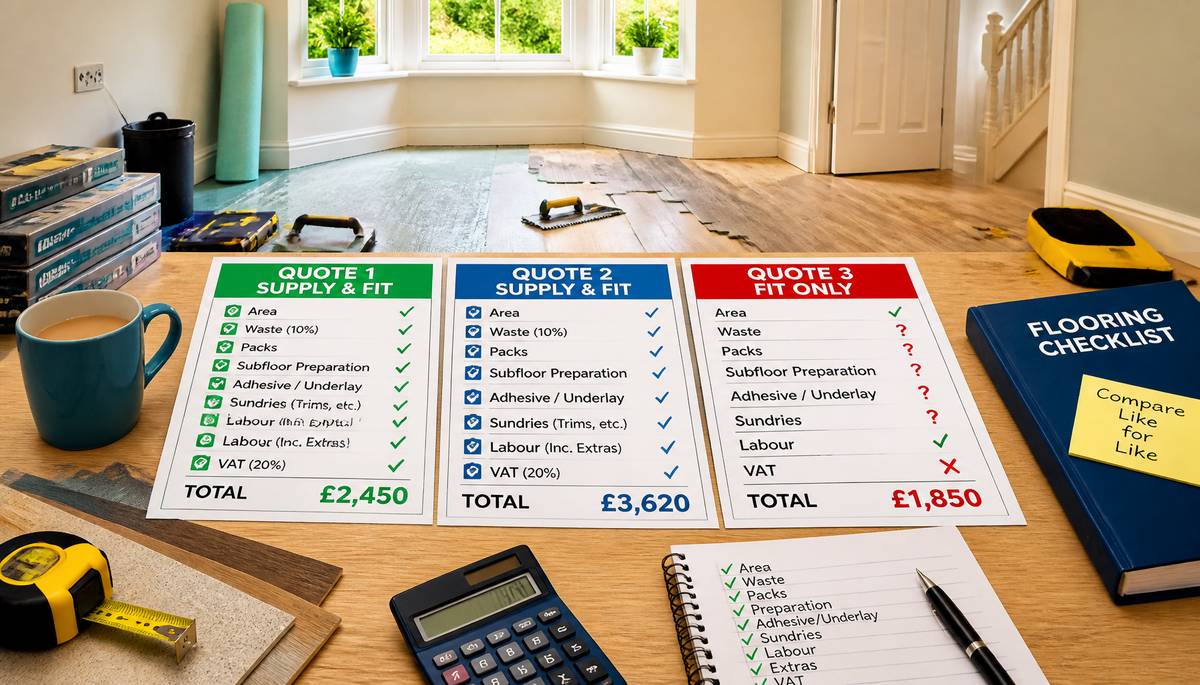 You ask three fitters to quote for the same room and get three very different figures. One looks like a bargain, one looks expensive, and it is hard to tell whether they are even pricing the same job. Usually they are not. A flooring quote is made of several parts, and the cheap one has often left a part out.
Here is what a good quote should contain, and how to check the sums yourself.
The area: what was actually measured?
Every quote starts with square metres. Check that all three fitters measured the same thing.
A room is measured at its widest and longest points, including into doorways, alcoves and bay windows. A 4.2 m by 3.6 m room is 15.12 square metres. If one quote says 15 and another says 17, ask why. One may have included the cupboard under the stairs, or allowed for waste, and the other may not.
The waste allowance
No floor is fitted without cutting. The offcuts from the edges of the room cannot always be reused, so extra material is always needed.
- Straight planks: allow about 5 to 10%.
- Herringbone: allow about 10 to 15%, because of the angled cuts along every wall.
- Awkward rooms with lots of corners, pipes or a diagonal layout need more.
A quote with no waste allowance is not cheaper. It just means you will run out near the end of the job.
Packs, not square metres
Flooring is sold in full packs. If your room needs 16.6 square metres including waste and the floor comes in packs of 3.685 square metres, you need five packs, which is 18.4 square metres. You pay for all five.
So a correct quote shows three numbers: the room area, the area with waste added, and the number of packs. If you would like to check a fitter's figures before you agree, a free flooring calculator will do the sum for you in a few seconds. Put in the room size and the pack size and it shows the packs needed.
Subfloor preparation
This is where quotes differ the most, and where the cheapest quote is most likely to have a gap.
A new floor is only as good as what is under it. Depending on the subfloor, the job may need:
- Removal and disposal of the old carpet, laminate or tiles.
- A moisture test on a concrete floor.
- A damp proof membrane if the reading is too high.
- Levelling compound (often called screed or latex) to give a smooth, flat base.
- Plywood over old floorboards before a glue-down floor.
Ask each fitter what they have allowed for. A fitter who says "we will see when the carpet comes up" is being honest, but ask for a price per square metre for levelling so there are no surprises.
Adhesive, underlay and sundries
Glue-down floors need adhesive. Coverage varies by product, but a rough guide for LVT is 3 to 3.5 square metres per kilogram, so a 15 square metre room needs about 5 kg. Click floors usually need an underlay instead.
Then there are the small items: primer, door bars, trims, scotia or new skirting. Each is cheap, but together they can add a meaningful amount. They should be listed, not hidden in a single line called "materials".
Labour
Fitting is usually priced per square metre, and the rate depends on the pattern. Herringbone, borders and feature strips take longer and cost more per metre than straight planks. Ask whether the labour price includes:
- Moving furniture
- Trimming doors so they clear the new floor
- Taking off and refitting skirting boards
- Fitting door bars at each threshold
These are the jobs that most often turn up later as "extras".
VAT
Check whether each quote is plus VAT or including VAT. A VAT registered firm will add 20%. A smaller, unregistered fitter will not charge VAT on labour. That alone can explain a large gap between two quotes, and it says nothing about the quality of the work.
Supply and fit, or fit only?
Some fitters supply the floor. Others are happy to fit a floor you have bought yourself. Fit-only can save money, but be clear about who is responsible if you order too little or the wrong adhesive. Agree the product and the quantity with your fitter before you buy.
A fair comparison
Put the three quotes side by side and tick off each part: area, waste, packs, preparation, adhesive or underlay, sundries, labour, extras and VAT. Where a line is missing, ask for it to be added.
Once every quote covers the same work, the right choice is usually much clearer. And it is often not the one that looked cheapest at first.
|
|

