How to Work Out What You're Drilling Into Before Hanging Something Heavy
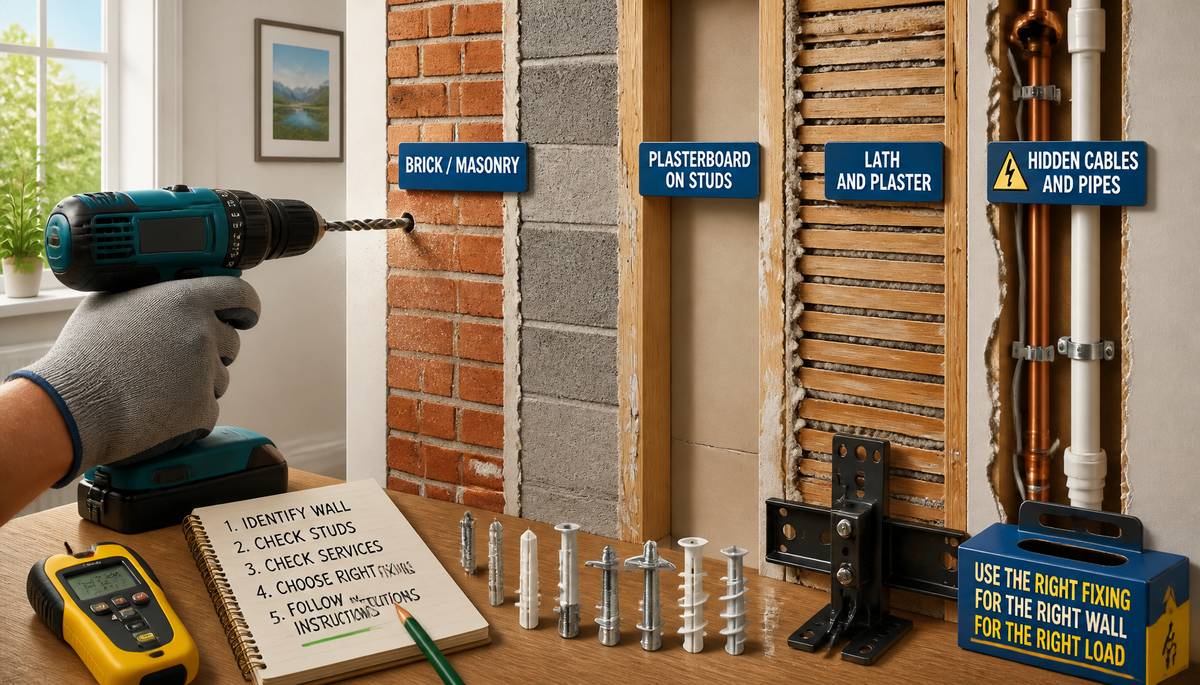 A drill bit disappearing neatly into a wall can create a dangerously convincing impression that everything is going according to plan. Sometimes it is. Sometimes the drill is heading into solid brick. Sometimes it has entered plasterboard with nothing particularly useful behind it. And occasionally it is embarking upon an unscheduled tour of the household wiring or plumbing.
Before hanging anything substantial, it is worth knowing what sort of wall you are dealing with. A lightweight picture frame is forgiving. A large mirror, floating shelf or wall-mounted television is considerably less interested in forgiveness. The fixing must suit both the wall material and the load it will eventually carry.
Start With Some Detective Work
Wall construction can often be narrowed down without making exploratory holes everywhere like an unusually determined woodpecker. External walls and substantial internal dividing walls are frequently brick, block or masonry covered with plaster. Internal partitions in newer properties are commonly plasterboard attached to timber or metal studs.
A gentle knock can provide a clue. Solid masonry tends to produce a dense, dull sound, while plasterboard between studs often sounds noticeably hollow. Moving your knuckles horizontally across a plasterboard wall may reveal changes in sound where studs are positioned behind it.
Stud detectors can help locate timber, metal and, depending on the model, electrical cables. They are useful rather than magical. Pipes, foil-backed insulation, metalwork and unusual construction can confuse readings, so a detector should form part of the investigation rather than being treated as an oracle with batteries.
Older properties introduce another possibility: lath and plaster. Traditionally, narrow timber strips were fixed across studs before several layers of plaster were applied. These walls can sound partly hollow but behave very differently from modern plasterboard when drilled. Their age can also make them brittle, meaning enthusiastic drilling may loosen considerably more plaster than intended.
Brick and Masonry Need the Right Approach
A solid brick or block wall generally provides excellent support for heavy objects when suitable fixings are installed correctly. Typically, this involves drilling an appropriately sized hole with a masonry bit and inserting a suitable wall plug or specialist anchor before driving in the screw.
The important detail is that the fixing needs to engage securely with the structural material rather than merely the decorative plaster covering it. A long screw pushed into an inadequate plug is not automatically stronger. It may simply be a longer version of the wrong solution.
Care is also needed with different masonry materials. Dense brick, concrete block, lightweight block and crumbly old brickwork do not all behave identically. Hammer-drill settings that make short work of hard masonry can be unnecessarily aggressive on fragile material.
Plasterboard Changes the Rules
Ordinary screws driven directly into plasterboard provide very limited support. For light loads, purpose-designed plasterboard fixings can spread the force over a larger area. Options include expanding anchors, self-drilling fixings and cavity fixings that open behind the board.
Heavier loads are a different matter. Where possible, attaching directly to timber studs provides a much stronger structural connection. This becomes particularly important with objects such as large televisions, substantial shelving and heavy mirrors, especially where the load projects away from the wall and creates additional leverage.
A television bracket, for example, does not merely have to support the television’s weight. An extending or articulated bracket can exert significantly greater forces on its fixing points when pulled away from the wall. Physics has an irritating habit of becoming interested in DIY precisely when you hoped it wouldn’t.
Hidden Hazards Deserve Respect
Identifying the wall material is only half the job. Before drilling, consider what might be running behind the surface. Electrical cables and water pipes may travel vertically or horizontally from sockets, switches, radiators and plumbing fixtures.
Never assume an apparently empty section of wall contains nothing. A suitable cable and pipe detector can reduce risk, but knowledge of likely service routes matters too. If there is uncertainty about what lies behind the intended drilling point, especially around kitchens, bathrooms or electrical fittings, investigation should come before enthusiasm.
A shelf being slightly crooked is annoying. A screw entering a live electrical cable or water pipe can turn a ten-minute job into a considerably more memorable afternoon.
Lath and Plaster Requires a Lighter Touch
Older lath-and-plaster walls deserve particular care because the visible surface can conceal a construction that is both strong in some places and surprisingly delicate in others. The plaster is supported by narrow timber laths, with gaps between them, and decades of movement may have weakened the bond between the two.
Drilling aggressively can crack the plaster or cause sections to loosen from the laths behind. Where a heavy object is involved, locating the structural timber studs is usually preferable to relying on the plaster itself. Pilot holes, careful drilling and appropriate fixings can make the difference between hanging a mirror and unexpectedly beginning a small restoration project.
Older walls may also have been repaired several times. A patch that looks identical from the room could conceal modern plasterboard, filler, masonry or the handiwork of somebody from 1974 whose philosophy appears to have been "use whatever is in the shed."
Weight Is Only Part of the Calculation
Manufacturers often provide maximum load figures for wall fixings, but those numbers need context. Their rated capacity may depend on a particular wall thickness, material, installation method and direction of load. A fixing capable of supporting a certain static weight under ideal conditions should not automatically be assumed suitable for every wall.
How an object applies force matters as well. A mirror hanging almost flush against a wall mainly pulls downward. A deep shelf loaded with books creates leverage because much of its weight sits farther away from the fixing points. An articulated television bracket can increase that effect whenever the screen is extended or repositioned.
There is also the question of consequences. If a tiny decorative shelf fails, the casualty might be a pot plant and some dignity. If a large television falls from above a cabinet, bed or children's play area, the potential consequences are considerably more serious.
Know When Guesswork Has Reached Its Limit
For straightforward lightweight items, identifying the wall and choosing the manufacturer's recommended fixing may be perfectly manageable. Heavy installations deserve a higher threshold of certainty.
Professional advice becomes sensible when the wall construction cannot be confidently identified, when masonry appears damaged or unusually soft, when studs cannot be located, or when electrical cables and plumbing may be close to the proposed fixing points. Very large mirrors, cabinets, televisions and heavily loaded shelving also justify extra caution.
A professional can assess not merely which anchor fits into a hole, but whether the underlying structure is capable of carrying the intended load safely. That distinction matters. A fixing can remain firmly attached to a piece of wall that itself is not sufficiently secure, which is technically impressive but practically useless.
Getting Your Fix
The safest approach begins before the drill leaves its case. Identify the likely wall construction, look for studs where appropriate, consider hidden services and select fixings specifically intended for the material and load involved. Follow the fixing manufacturer's instructions rather than improvising around whatever mysterious collection of screws has accumulated in the kitchen drawer.
Walls conceal far more variation than their smooth painted surfaces suggest. Brick, block, plasterboard and lath and plaster each demand different treatment, and even two apparently identical walls can hide completely different structures. Taking a few minutes to establish what lies beneath the paint can prevent damaged plaster, failed fixings and expensive objects discovering gravity.
Heavy things belong on walls only when the wall, fixing and installation method agree on the arrangement. When any one of those remains uncertain, getting knowledgeable help is considerably cheaper than discovering the answer through a sudden crash from the next room.
|
|

